
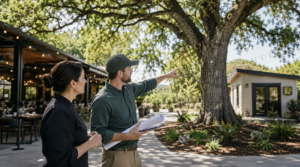
Restaurant growth does not always mean opening another dining room across town. Today’s restaurant owners, hospitality groups, property investors, and developers are looking at real estate more creatively. Some are expanding into mixed-use properties, adding offices or support facilities, developing adjacent parcels, creating housing connected with larger properties, or finding new ways to make underused land more productive.
That broader approach to development is happening at a time when the restaurant industry continues to evolve. The National Restaurant Association’s 2026 State of the Restaurant Industry report projects restaurant and foodservice sales of approximately $1.55 trillion in 2026, even as operators continue dealing with cost pressures and changing consumer behavior. Growth remains attractive, but every expansion decision has to be approached with greater attention to cost, permitting, real estate, and long-term use of the property.
For properties that include an accessory dwelling unit or plans for one, trees can become an important part of that development equation. Mature trees, protected species, root systems, utility locations, construction access, setbacks, and local preservation rules can influence where a structure can be placed and how construction proceeds.
Obtaining an Arborist Report for ADU early in the planning process can give property owners, architects, contractors, and developers a clearer understanding of existing trees and how proposed construction may affect them. A professional report may document tree species, size, condition, protected status, construction impacts, and recommended protection measures that can become relevant during local planning and permitting.
Restaurant Expansion Is Becoming More Strategic
Restaurant expansion remains active, but successful growth increasingly depends on choosing the right property and developing it intelligently. Current restaurant expansion news demonstrates how operators are examining market size, development costs, restaurant formats, real estate flexibility, and the economics of individual locations rather than relying solely on aggressive unit growth.
Recent reporting from QSR Magazine on restaurant growth beyond major cities has highlighted the movement of restaurant brands toward suburban and smaller markets, where changing population patterns and operating costs are influencing development decisions. This type of expansion often introduces restaurant operators to properties that are larger, less densely developed, and more likely to contain mature landscaping or established trees.
That shift changes the development process. An infill restaurant in a dense commercial center may have relatively little untouched land. A suburban, mixed-use, or redevelopment property can present an entirely different situation. Trees may stand near proposed foundations, parking improvements, utility trenches, patios, secondary buildings, or other planned construction.
The physical characteristics of the site can therefore become just as significant as the restaurant concept itself.
Real Estate Has Become a Major Part of Restaurant Growth
A restaurant site has to do more than provide enough square footage for a kitchen and dining area. Operators have to consider parking, visibility, traffic flow, utilities, delivery access, outdoor spaces, zoning, neighboring uses, and the possibility of future improvements.
Restaurant development reporting reflects that reality. Restaurant Dive’s coverage of franchise growth in 2026 shows restaurant concepts using new franchise agreements, new real estate types, and new geographic markets to accelerate expansion. The development strategy behind a growing restaurant brand is increasingly tied to finding properties that offer flexibility as well as immediate operational value.
For individual restaurant owners and investors, flexibility may include a property with multiple structures or enough land for future additions. In locations where residential development is legally permitted as part of the property configuration, an accessory dwelling unit can potentially become another consideration in the overall development plan.
Local zoning and land-use requirements always control what is allowed. An ADU should never be assumed to be permissible simply because space exists on a parcel. When it is permitted, however, tree requirements can quickly become part of the planning process.
Trees Can Affect Much More Than the Building Footprint
One of the most common mistakes in construction planning is focusing only on where a tree trunk is located.
A mature tree occupies considerably more space below and above ground than the trunk suggests. Roots can extend through areas proposed for grading, foundations, drainage improvements, utility trenches, walkways, parking, or construction access. Branches and canopy spread can also affect equipment movement and building clearance.
A structure may appear to fit comfortably beside a tree on a preliminary site plan while construction activity still reaches an important portion of the root system.
Professional tree assessment can identify these issues before contractors begin excavation. Depending on the property and local requirements, an arborist may document tree locations, species, trunk measurements, condition, health, potential construction conflicts, tree protection zones, and recommended mitigation measures.
That information gives the design team an opportunity to respond while changes are still easier to make.
Restaurant Development News Shows the Importance of Planning Ahead
Growth announcements often focus on restaurant openings, new markets, franchise agreements, and impressive unit counts. Behind every successful opening, however, is an extensive development process involving real estate selection, plans, approvals, financing, construction, and operations.
Nation’s Restaurant News coverage of independent restaurant expansion continues to track restaurant groups moving into new markets and developing additional locations. Those stories demonstrate that expansion is not limited to the largest national chains. Independent restaurants and regional hospitality groups are also making significant real estate decisions as they grow.
The broader United States restaurant industry overview on Wikipedia also illustrates the enormous economic reach of restaurants across the country. The industry includes major national brands as well as a vast number of smaller and independently operated businesses, making restaurant real estate development an important part of communities throughout the United States.
For owners investing substantial money in property improvements, identifying development constraints early can protect both the project schedule and the investment.
Local Tree Regulations Can Change the Development Plan
Tree regulations vary widely between municipalities. A tree that can be altered or removed with limited restrictions in one community may receive significant protection in another.
Cities may regulate designated heritage trees, native species, trees over certain trunk diameters, street trees, trees within environmentally sensitive areas, or trees connected with approved development plans. Some jurisdictions also require replacement planting or mitigation when protected trees are removed.
These rules are important because the consequences can extend beyond landscaping. A protected tree located near the planned structure may affect the placement of the building, excavation methods, utility routing, foundation design, or access for construction equipment.
Discovering those restrictions after architectural plans have been finalized can create additional design work and delay permitting.
An early arboricultural assessment allows the tree information to become part of the site-planning process instead of becoming a problem after major decisions have already been made.
Expansion Costs Make Avoidable Delays More Significant
Restaurant development requires substantial capital, and operators have become increasingly sensitive to the economics of new locations.
Restaurant Business reporting on incentives designed to encourage restaurant expansion has documented how restaurant brands have used financial incentives to encourage franchisees to continue opening locations. The fact that brands are willing to provide significant development incentives illustrates how important construction economics have become to restaurant growth strategies.
Every redesign, permitting delay, construction change, or unexpected site condition has the potential to affect those economics.
Tree-related issues are only one component of a development budget, but they can become expensive when discovered late. Moving a foundation, rerouting utilities, changing excavation methods, modifying grading, replacing protected trees, or stopping construction while additional approvals are obtained can have consequences beyond the direct cost of the tree work.
Planning is generally less expensive than correcting an avoidable conflict during construction.
Restaurant Brands Are Looking for More Flexible Development Models
One of the clearest trends in restaurant expansion is flexibility.
Some growing concepts are using traditional freestanding restaurants, while others are exploring endcaps, inline locations, co-branded spaces, nontraditional venues, remodeled buildings, and new prototypes.
Restaurant Dive recently reported that Freddy’s was expanding its real estate approach to include more flexible formats as part of its growth strategy. The company’s development plans demonstrate how restaurant operators are paying close attention to the cost and configuration of the physical property rather than treating every new location the same.
That same principle applies to broader property development. The site should be evaluated as a whole.
Existing structures, trees, parking areas, drainage, utilities, neighboring properties, future construction, and usable open space all interact. Decisions made for one part of a property can affect what becomes possible elsewhere.
A Tree Report Can Help Architects Design Around Existing Conditions
Arborist documentation is particularly useful when it reaches the architect or designer before the final site plan is complete.
If a valuable tree has a significant root protection area, the building may be shifted slightly. A walkway may be rerouted. Utility trenches may be placed elsewhere. Construction access might be restricted to another portion of the property. Special foundation or excavation techniques may be considered where appropriate.
These adjustments are usually easier to evaluate on plans than after equipment arrives on the property.
A thoughtful development approach also does not assume that every tree creating a conflict needs to be removed. In some situations, retaining established trees can preserve shade, visual screening, character, and landscaping that would take decades to replace.
The objective is to understand the site well enough to make informed decisions.
Current Restaurant Growth Reinforces the Value of Site Due Diligence
Restaurant expansion continues despite a challenging operating environment. The U.S. Census Bureau’s retail and food services sales reporting remains one of the important sources for tracking consumer spending across retail and food-service businesses, while restaurant industry organizations and trade publications continue to document brands moving into new markets.
Individual expansion announcements reinforce how much development is still taking place. FSR Magazine’s coverage of new restaurant openings and market expansion has documented hospitality groups adding locations across major growth markets, including expansion across state lines.
At the same time, restaurant operators face high construction costs, labor expenses, financing considerations, and narrow operating margins. That combination makes due diligence increasingly valuable.
Tree assessment belongs alongside surveys, zoning reviews, utility research, environmental considerations, architectural planning, and other site investigations that help an owner understand a property before committing heavily to construction.
Tree Protection Also Supports Long-Term Property Value
Existing mature trees can be assets when they are healthy, appropriately located, and properly maintained.
Trees can provide shade for outdoor areas, create visual separation from neighboring properties, soften large parking areas, and improve the overall appearance of a developed site. For restaurants with patios, courtyards, event areas, or mixed-use property features, established landscaping can become part of the character guests associate with the location.
Construction damage may not always become visible immediately. Root cutting, soil compaction, grade changes, trunk injuries, and other disturbances can affect tree health long after the contractors have left.
Protecting appropriate trees during construction can therefore serve both regulatory and practical purposes.
A professional assessment gives the project team information that helps distinguish trees worth preserving, trees requiring special protection, trees that present concerns, and situations in which removal may be appropriate subject to local requirements.
Early Coordination Creates a Smoother Development Process
Restaurant owners already coordinate with architects, engineers, contractors, lenders, real estate professionals, municipal planners, equipment vendors, utility companies, and numerous other specialists during an expansion.
Tree professionals can become another valuable part of that team when the property contains trees that may be affected by development.
Early coordination gives everyone better information. The architect understands the tree constraints. The contractor knows which areas may require protection. The owner has a clearer picture of possible costs. The municipality receives documentation that addresses applicable tree requirements.
That is far preferable to discovering a protected tree, major root conflict, or required mitigation measure after construction plans and schedules have been established.
Conclusion
Restaurant expansion is becoming increasingly sophisticated. Operators are evaluating new markets, different building formats, mixed-use opportunities, redevelopment properties, and flexible real estate strategies as they look for sustainable ways to grow.
That makes careful site planning more important than ever.
When a property includes plans for an accessory dwelling unit and established trees are nearby, tree assessment should be considered early in the development process. Understanding tree condition, root zones, protected status, construction impacts, and local requirements can help architects and property owners make better decisions before plans become difficult or expensive to change.
The most successful developments are rarely the ones that simply move fastest. They are the ones that identify potential obstacles early, coordinate the right professionals, and build a realistic plan around the actual conditions of the property.
For restaurant owners, hospitality groups, and property investors pursuing expansion, that level of preparation can protect the construction schedule, reduce avoidable surprises, preserve valuable site features, and create a stronger foundation for whatever comes next.