
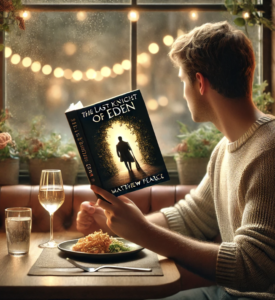
Some books demand silence, a locked door, and a long stretch of uninterrupted time. The Last Knight of Eden is not that kind of book. It is the kind that travels well—dark, modern, faith-laced fantasy that feels even more vivid when you read it in the soft hum of a restaurant: clinking glasses, low conversation, warm lighting, and that moment between courses when you get to sink into another world without abandoning the one in front of you.
Matthew Pearce’s story follows Ezra Thorne, a young man carrying the weight of a fractured home and a mind he does not fully trust, who disappears into the underground tunnels of London and wakes something ancient beneath the city’s skin. A single spoken name drives a monstrous presence back into the dark, and Ezra is pulled into the Edenic Order, a secret brotherhood sworn to guard the living Word against creatures older than history.
A Christian Fantasy That Feels Immediate and Modern ✨
What makes The Last Knight of Eden such a strong Christian fantasy pick for restaurant reading is the way it anchors spiritual power in a setting that feels close enough to touch. London is not a distant fairytale kingdom here. It is streets and tunnels, stone and shadow, everyday life above and mythic warfare beneath. That contrast mirrors the exact feeling of sitting in a restaurant: the ordinary made special, the familiar turned cinematic by a little atmosphere and intention.
Ezra’s journey is also built on tension that does not require perfect quiet to land. He is not stepping into faith as a decorative theme or a gentle vibe. He is colliding with it as something alive, dangerous, and demanding. Inside the Order’s Cloister, Ezra learns that scripture is not merely written—it is spoken, and some voices are born to carry it. Relics respond to him. Scrolls answer his breath. Visions arrive like warnings.
That is restaurant-friendly storytelling because it reads like a series of charged moments. You can absorb a scene, set the book down when your food arrives, and pick it back up without losing the emotional thread. It is immersive without being fragile.
The Story’s Natural Rhythm Fits the Pace of Dining 🕯️
Restaurants have built-in “chapters.” You arrive. You settle. You order. You wait. You taste. You pause. You talk. You linger. The Last Knight of Eden matches that rhythm with a narrative that moves in pulses: discovery, threat, training, doubt, revelation, escalation.
Ezra’s life does not slowly drift into fantasy—it snaps into it. One minute he is a suspended student wrestling with the fear of betrayal from his own mind, and the next he is confronting what lives under a city and what wakes when the wrong thing is spoken aloud. That kind of momentum works beautifully between sips and bites. Even a short reading window can deliver something satisfying: a new clue, a new danger, a new crack in the walls of what Ezra believed was real.
And because the book is a dark modern fantasy, the atmosphere of a restaurant can act like an amplifier instead of a distraction. Low light makes the Cloister feel colder. Background noise makes underground tunnels feel more alive. A candle on the table makes the imagery lean sharper and more mythic.
Faith in This World Is Not Gentle, and That’s the Point ⚔️
Some Christian fantasy stories keep faith at arm’s length, afraid of weight and consequence. The Last Knight of Eden leans the other direction. It treats faith like a force that can burn, protect, judge, and demand courage. The Word in this story is living, carried by voice, guarded by oath, contested by ancient powers.
That seriousness is part of why it makes such a strong “dining read.” Restaurants can be places where people celebrate, reconcile, plan, or quietly reset. You are already in a setting that invites reflection, even if it is subtle. When you pair that environment with a book where spiritual power has consequence, the story lands with extra gravity.
Ezra is not presented as a polished saint. He is wounded, uncertain, and carrying internal fear. The Order sees him as miracle to some and as risk to others—especially Miriam, the blade-wielding knight who views him as danger waiting to happen. Power without control has broken the world before, and the story treats that warning as real.
That tension—gift versus threat, calling versus collapse—creates the kind of emotional pull that keeps you turning pages even when your entrée shows up.
A Book That Respects Your Attention Span Without Dimming Its Depth 🍷
Reading at a restaurant is not the same as reading on a couch. You are sharing attention with a menu, a server, a companion, your own senses. The best restaurant books do not punish you for looking up. They reward you for returning.
The Last Knight of Eden does that by building a world that is vivid and symbolic without requiring you to memorize a glossary to enjoy it. You can read a paragraph, catch an image, feel the meaning, and hold onto it while you take a bite. When you return, the tone snaps back into place quickly because the stakes are emotional and spiritual, not just technical.
It also helps that the story’s core ingredients are instantly graspable: secret orders, hidden histories, mythic conflict beneath modern life, and a reluctant hero who did not ask to be chosen. Those elements are sturdy. They travel well.
The Restaurant Setting Makes the Hidden-World Theme Hit Harder 🌙
There is a special kind of magic in reading a book about hidden realities while sitting in a public place. In The Last Knight of Eden, the surface world is normal and the underworld is listening. Sacred ground holds secrets. Long-sealed forces stir. Nephilim move beneath what people assume is safe.
Now place that feeling on top of a restaurant table.
Around you, people are laughing, ordering dessert, scrolling their phones, celebrating birthdays. The room is bright with ordinary life. You, meanwhile, are reading about a world where the unseen presses close to the seen, where the wrong breath can wake something, and where spoken truth carries power. That contrast turns a simple dinner into an experience. It makes the story feel closer, like it could be happening under the building you are sitting in.
It is not about pretending reality is haunted. It is about letting fiction sharpen your awareness: the sense that life is layered, that meaning runs deeper than what is obvious, that the world may be louder than it looks.
A Quiet Ritual That Pairs Well With Hospitality and Restaurant Culture 🍽️✨
A great restaurant meal is not just fuel—it is hospitality, atmosphere, pacing, and care. The restaurant industry talks about those elements constantly because they shape how people feel when they dine. For anyone who likes weaving books into everyday life, it is fun to notice how the worlds overlap.
Industry outlets like Nation’s Restaurant News, Restaurant Business, and Restaurant Dive regularly explore how experience, ambience, and consumer behavior shape the way people gather for meals. The broader conversation shows up through organizations such as the National Restaurant Association Press Releases and trade coverage like QSR Magazine and Bar & Restaurant. Those sources exist because dining is not only about food—it is about the moment.
That is exactly why The Last Knight of Eden works during dinner. It is a story built around the idea that words matter, that what is spoken carries weight, and that hidden vows shape visible life. In a place designed for human connection and shared experience, that theme lands with extra impact.
Conclusion: The Best Christian Fantasy Restaurant Read Feels Like an Experience, Not a Task 🕯️📖
The Last Knight of Eden is one of the best Christian fantasy books to read while dining at a restaurant because it meets the moment you are already in. It is modern enough to feel immediate, dark enough to feel cinematic, and spiritually charged enough to leave an echo after you close the cover. It delivers scenes you can savor between courses, themes you can carry quietly back into the room, and a sense of hidden-world wonder that pairs perfectly with the soft ritual of a meal.
Ezra Thorne’s story is not gentle faith as decoration. It is faith as fire, scripture as living voice, and calling as something that can save what remains or burn it down. That kind of Christian fantasy does not just entertain. It turns dinner into a doorway. ✨